
inexplictly bound - written in stardust
Phases
Plasma
Gasses
Liquids
Solids
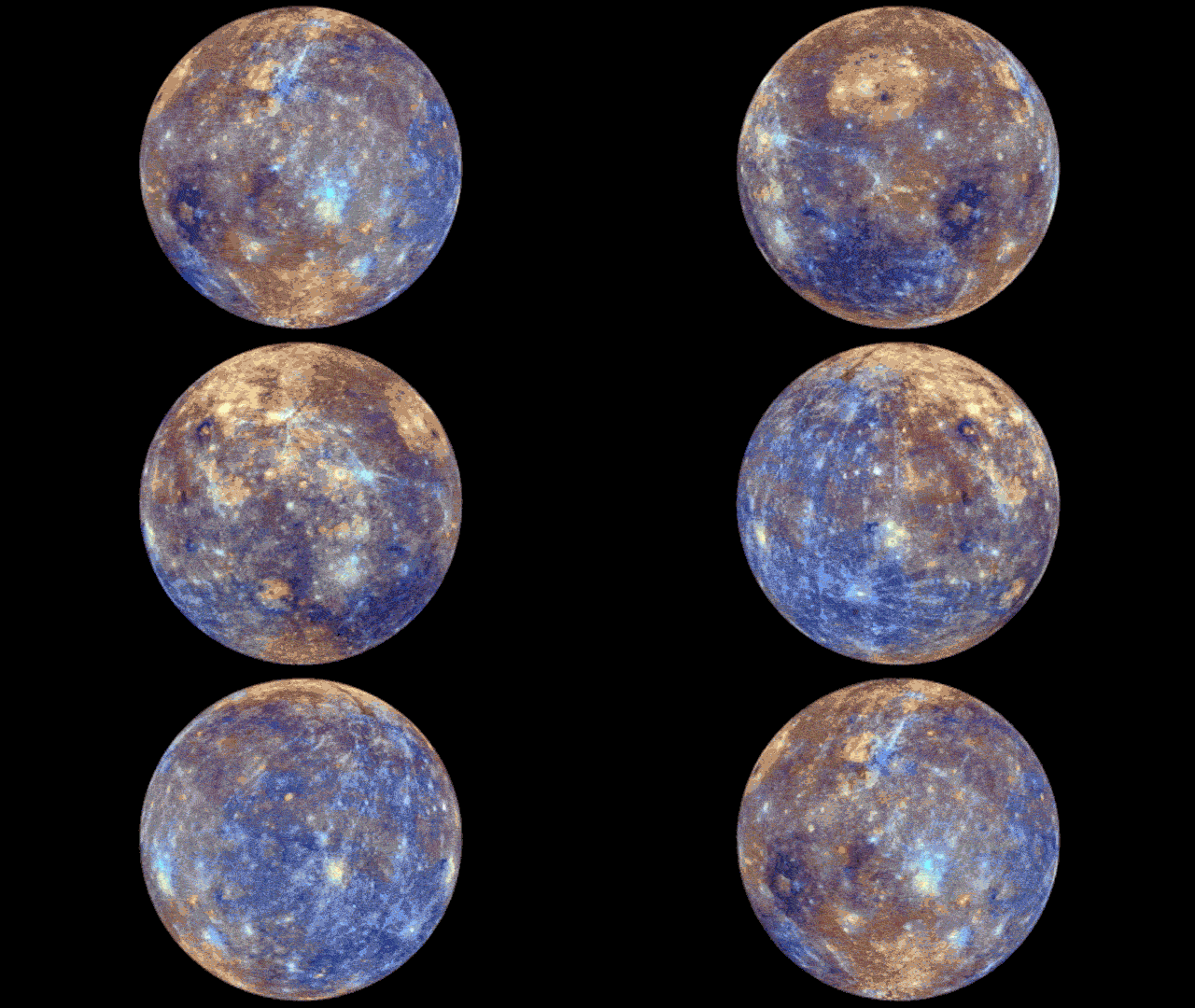
Mercury is a fascinating solid planet, being the smallest and closest to the Sun in our solar system. Despite its proximity to the Sun, Mercury is not the hottest planet due to its thin atmosphere and lack of heat retention. Its surface is heavily cratered and rocky, consisting of silicate rock and metallic compounds. These solid characteristics make Mercury a prime example of how planetary solids can vary dramatically in composition and appearance depending on their distance from stellar radiation.
Solids are defined by their rigid molecular structure, where particles are tightly bonded and held in fixed positions. This gives solids their characteristic properties: they maintain a definite shape and volume, resist deformation, and have the highest density among the three primary states of matter. The particles within a solid vibrate in place but cannot move freely like those in liquids or gases, creating the structural integrity we observe in everyday objects.
The formation of solids occurs when matter is cooled to temperatures where molecular motion becomes too restricted for particles to flow. Different materials solidify at different temperatures, a property known as the melting point. Crystalline solids, like salt and diamonds, form ordered lattice structures, while amorphous solids, such as glass, lack this organized arrangement yet still maintain solid properties through their rigid bonding.
Solids play a crucial role in the universe and our daily lives, providing the foundation for structures, tools, and planets. From the rocky bodies of terrestrial planets to the metals and minerals we extract and use, solids demonstrate remarkable diversity in their properties and applications. Understanding solids helps us comprehend planetary science, materials engineering, and the fundamental nature of matter itself.